How Canyon Falls Tax Bills Change From One Section to the Next
November 19, 2026
Two houses in Canyon Falls can share the same builder, the same trail system and similar list prices. Why can their annual tax bills be hundreds of dollars apart for every $100,000 of value? Canyon Falls is divided by town and special-district boundaries, and buyers often don't see them until the closing paperwork. A home's location decides which town it is in and whether the lot also pays a special district that is still repaying the money used to build the community's roads and pipes.
Before you compare two Canyon Falls homes on price, compare the taxing units printed on each one's tax statement. The rest of this post explains why that matters and what the current numbers are.
A Canyon Falls listing usually doesn't tell you which tax setup a home falls under, but the documents do. The Canyon Falls Water Control and Improvement District No. 2 posts a "Notice to Purchaser" with its audits and budgets on its public documents page. Canyon Falls MUD No. 1 posts its own audit and Notice to Purchaser on its public information page.
In practice, I ask for the seller's most recent tax statement early and read every taxing unit on it.
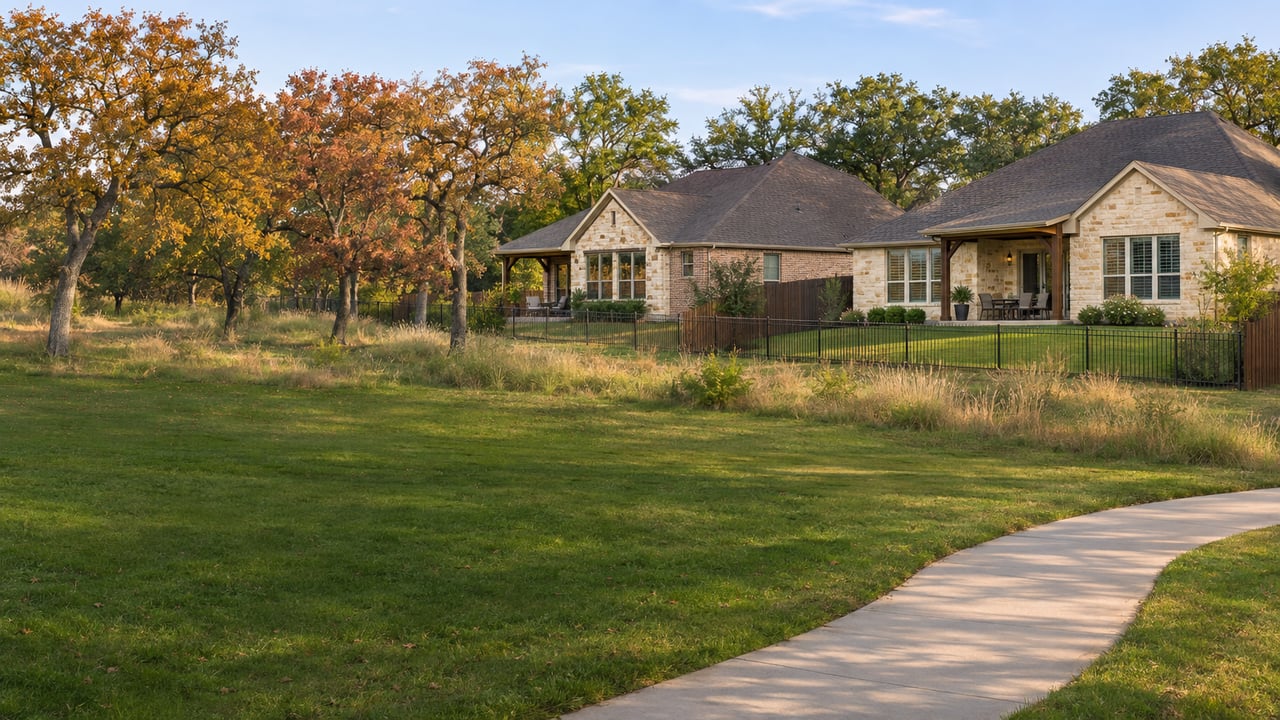
According to the district's October 2018 bond offering statement, Canyon Falls covers about 1,200 acres. About 514 of those acres are inside the Town of Northlake and within WCID No. 2. About 173 acres are in the extraterritorial jurisdiction of the Town of Argyle and within Canyon Falls MUD No. 1. The rest is inside the Town of Flower Mound and outside any special district. The same statement says part of the community is in Argyle ISD and the rest is in Northwest ISD.
A February 2018 City of Denton staff report explains how this happened. The developer, Development Planning & Financial Group, asked the Town of Flower Mound to create a public improvement district to finance part of the infrastructure. The town did not approve it. The developer paid for the roadway and water and wastewater infrastructure on that side and received town rebates on portions of the water and wastewater impact fees. In the Northlake and Argyle-ETJ sections, the districts were set up to issue bonds, and property owners there repay those bonds through their tax rate.
So the infrastructure was paid for differently depending on the section. In one section the cost was settled before the homes were sold. In the other two, the cost is still being repaid through the tax bill.
Denton County publishes adopted rates for every taxing unit on its truth-in-taxation page. These are the Tax Year 2026 figures, shown per $100,000 of taxable value before any exemptions:
| Taxing unit, Tax Year 2026 | Flower Mound section | Northlake section | MUD No. 1 section |
|---|---|---|---|
| Town | $387.28 | $295.00 | Depends on current town status |
| Special district | None | $630.00 | $730.00 |
| Denton County | $183.39 | $183.39 | $183.39 |
| Subtotal before school tax | $570.67 | $1,108.39 | $913.39 plus any town rate |
| School district | Argyle ISD $1,155.80 or Northwest ISD $1,063.80, by address | Same | Same |
Start with the town rates. Northlake's 2026 rate is lower than Flower Mound's by $0.092277 per $100, or about $92 for every $100,000 of value. The WCID rate adds $630, so Northlake's lower town rate offsets only a small part of it. Before school taxes, the Northlake section's bill is about $538 higher per $100,000 than the Flower Mound section's. On a home with $500,000 of taxable value, that's roughly $2,690 a year.
The school row shows the same kind of gap. For 2026, Argyle ISD's rate is about $92 per $100,000 higher than Northwest ISD's, which is almost exactly the gap between the two town rates. In a single community, the district line moves the bill several times more than either the town line or the school line.
Denton County splits each adopted rate into maintenance and operations, which pays for running the district, and debt service, which repays bonds. For Tax Year 2026:
The amount owed explains why the debt share is so large. WCID No. 2's audit for the fiscal year ending June 30, 2025 shows $41,645,000 in bond principal outstanding. Its bonds mature through February 15, 2048. The same audit shows $1,502,875 still due to the developer, after the district reimbursed $528,311 during that fiscal year. MUD No. 1's audit for the same period shows $19,130,000 in bonds outstanding, with its Series 2024 utility bonds maturing as late as February 15, 2048.
So the bonds currently outstanding in both districts run to 2048, more than two decades after a purchase this year.
The trend through Tax Year 2026 is good news for current owners. The county table shows the MUD rate at $0.9291 in 2022, $0.8103 in 2023, $0.80 in 2024, $0.75 in 2025 and $0.73 in 2026. The WCID rate went from $0.6815 in 2022 to $0.66 in 2023 and 2024, then to $0.61 in 2025 and $0.63 in 2026. As more homes and higher values spread the debt over a bigger tax base, the rate needed to cover it can fall.
That trend can change. As of June 30, 2025, MUD No. 1 had $41,265,000 in utility bonds and $37,550,000 in road bonds that voters had authorized but the district had not yet issued. Its 2025 audit says the bonds are repaid from an annual property tax "without limitation as to rate or amount." Authorization doesn't mean the district will issue all of it.
This is the order I use when a client is choosing between two Canyon Falls homes:
None of this makes one section better than another. Each one represents a different trade-off between purchase price and ongoing cost, and you can only judge those trade-offs once the tax numbers are part of the comparison. This post is general information, not tax, legal or financial advice. Confirm your own situation with a tax professional and with the taxing units' official records.
Does Canyon Falls have a PID? The 2018 City of Denton report says Flower Mound did not approve the PID the developer requested. The special-district costs in Canyon Falls come from MUD No. 1 and WCID No. 2, and they're charged as property-tax rates.
Who provides water and trash service? The same report says Flower Mound and Northlake provide water, wastewater, solid waste and recycling service to the development.
Where do the district rates come from? Each district's board adopts its rate, and Denton County publishes the rates with their maintenance and debt split on its truth-in-taxation page. Each district's financial reports are on the MUD No. 1 public information page and on the WCID No. 2 documents page.
If you're weighing two Canyon Falls homes, or deciding how a district rate affects the price of a home you're selling, the Shaune Corbett Group will go through the tax statements with you. If you're selling, start with a home valuation that factors in the tax rate. Let's Connect.
Stay up to date on the latest real estate trends.

I believe in treating people fairly, telling clients what they need to hear rather than simply what they want to hear, keeping my word, and taking responsibility for the commitments I make.